
Our Fabric Production
Process
Explore each facet of our fabric creation process, highlighting the precision and technology we employ at every stage to produce fabrics that delight our customers worldwide.

Raw Material
Yarn, the main raw material is sourced from the region, while dyes and chemicals are sourced both regionally and from Europe. All raw materials undergo thorough inspection to ensure that they meet the stipulated compliance standards and quality standards that underpin the excellence of our fabrics.
Colour Laboratory
Spectra readings are captured for all lab-dips to ensure that DELTA values are maintained below the specified limits.
Lab-dips are continually evaluated to ensure highest quality is met with lowest cost.


Knitting
Weft-knit fabric is crafted using our state-of-the-art Orizio, Santec, Fukushara, and Mayer knitting machines that are capable of Single Jersey, Double Jersey (also known as Interlock) and Rib fabrics. We also possess a comprehensive Flat Knit knitting section which is used to produce bands and collars.
Our mill is capable of producing a variety of designs or structures on weft-knit fabrics, such as Pique, Waffle, Slub yarn designs, Metallic yarn designs, Inlay (loopback).
All greige is checked on-line for defects while being manufactured in our Knitting department, and again re-inspected by our quality assurance department to ensure that only fabrics of the right quality are passed on to the next process.
Dyeing
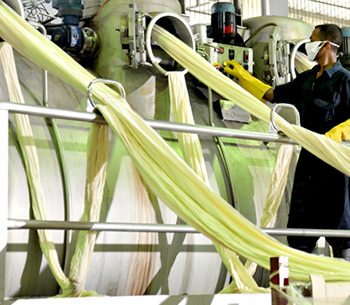
Our dye-house operations are controlled using Sedo and OrgaTEX systems, while the colour of the fabric is achieved and repeated by an automated chemical dispensing system.
Printing
Our CAD division in the printing department is equipped with the latest CAD/CAM software from AVA, and our screen engraving and screen preparation divisions use laser engraving technology to engrave print screens for accuracy and consistency.
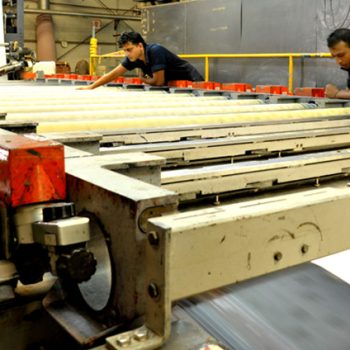
Our eight-colour Rotary screen printing machines are capable of producing full coverage prints, vertical stripes, prints with tight registration or intricate designs on cotton, cotton-blends, polyester, polyester-blends and viscose fabrics, including pigment printing.
Brushing
Fabric is brushed using a fuzzy surface by abrading the cloth and pulling the fibre ends to the surface.


Sueding
Shearing
This fabric cutting operation determines the height of the fibre and cuts off any fibres that are irregularly raised during the raising process.
Sheared fabric has the appearance of velvet fabric and has a soft feel to the hand.


Combing
Finishing
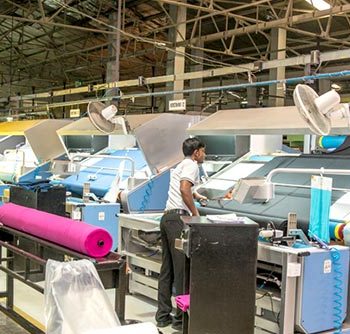
Our world-class finishing machinery from Babcock, Santex, Sperotto Rimar and Tong Yang, incorporate in-built automatic controls to guarantee precise physical measurements in every fabric we produce. All our fabrics are also inspected on-line at this stage to ensure that these physical parameters are achieved.
Our finishing capabilities also include moisture management, water repellent, UV protection, aguacate and anti-microbial.
Only the fabrics of the right quality are passed onto the next division – Quality Assurance.

Final Inspection / Quality Control
All fabrics undergo a rigorous 100% final inspection for any visual defects, colour inconsistencies or inaccuracies, and the desired physical properties to ensure that only the right quality fabrics reach our customers.
Our Quality Policy is communicated and understood at all levels within the organisation.
Process Control
FastReact, a specialised tool tailored for the textile and fashion industry, is used for production planning. This enables us to achieve enhanced operational efficiency through streamlined coordination between Sales & Marketing, Procurement, and Production.
